Which lighting should you choose? Warm, neutral or cool.
Discover how to choose the most suitable light bulb for lighting your rooms and which one provides the most light.
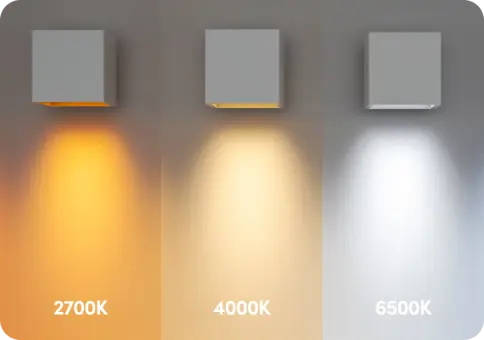
What is meant by color temperature.
The main aspect to consider remains the color temperature or hue, which is expressed in Kelvin (K). This parameter represents the color emitted by the light, distinguishing between warm, neutral and cool, and greatly influences the atmosphere of the room by adapting it to different purposes. Currently, it is mainly divided into three categories:


Cool light (5000 - 6500K)
The right LED light bulb in three simple steps.

Check the base: for every type of light bulb there is a different base that also varies in size.

Choose the color temperature: light bulbs have three different color temperatures (2700K, 4000K, 6500K).

Check the lumens needed for the room: consider that the lighting requirement varies depending on the room and the activity carried out.
Is it true that cool light illuminates more?
It is a false myth, with the same number of lumens, our eye perceives cool light as brighter and creates sharper shadows, making the outlines of illuminated objects stand out. It is necessary, in fact, to keep in mind that light tone and luminous flux are two distinct metrics: the first measures the color distinguishing between warm and cool, while the second considers the lighting power.
Speaking instead of more technical parameters, first of all it is necessary to be able to distinguish between the different types of bases:
- Screw bases: the code E27 defines a large base while the code E14 identifies a small base.
- Bayonet bases: GU10 identifies a medium base while GU5.3 / MR16 a small one.
- Pin bases: G9 identifies a very small base while G4 a micro base.
By CRI (Color Rendering Index) is meant the color rendering index, that is the ability to reproduce colors in a natural and realistic way. Expressed on a scale from 0 to 100, it sees standard LED bulbs positioned around a value of 80 (with correct but sometimes dull colors), while devices with CRI higher than 90 offer more vivid tones, reducing visual fatigue.
Luminous flux represents the amount of light generated by the LED light bulb and is expressed in lumens. The lighting requirement varies according to the room and the activity carried out; in many domestic environments an indicative level of between 100 and 200 lumens per square meter is considered.